






By The Covenant Tribune
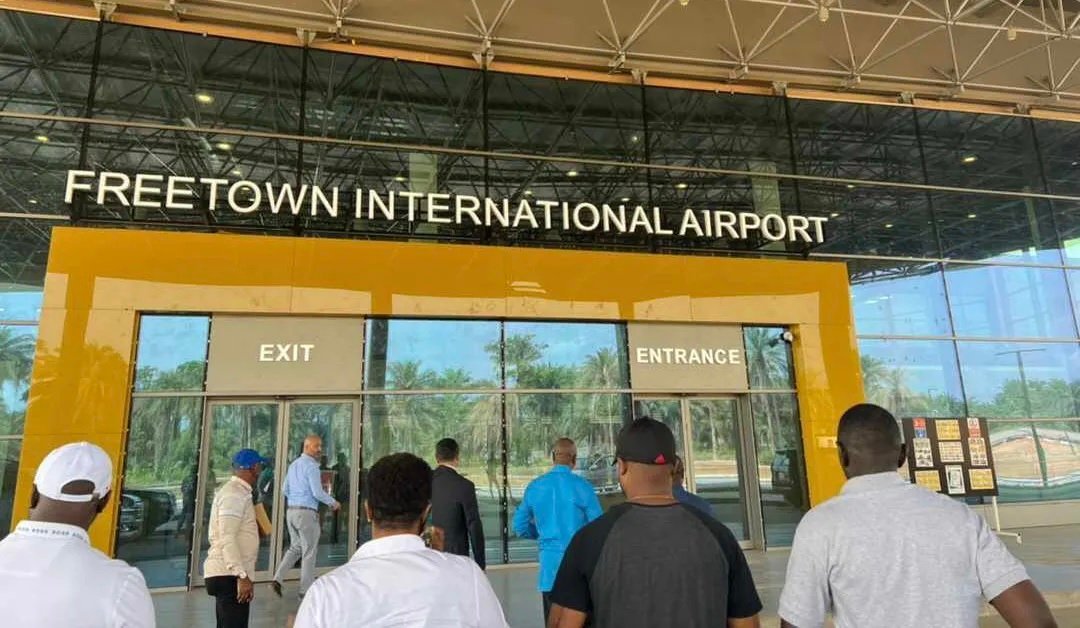
On 7 May 2026, the Head of Immigration at Freetown International Airport, Lungi, issued a circular to all airlines operating at the airport — ASKY Airlines, Ethiopian Airlines, Royal Air Maroc, Turkish Airlines, Brussels Airlines, Air Peace, Air Sierra Leone, and Kenya Airways. The circular introduced new verification requirements for non-national passengers claiming residence in Sierra Leone.
Twenty-four hours later, his boss withdrew it.
Chief Immigration Officer Moses Tiffa Baio issued a formal directive on 8 May 2026 setting aside the previous notice, assuring airlines that there have been no changes to current immigration entry procedures. He thanked the airlines for their cooperation and emphasised that his directive superseded the earlier correspondence.
In bureaucratic language, that is a polite way of saying: someone acted without authority, caused alarm across eight international carriers, and had to be publicly corrected.
A Symptom, Not the Disease
One might be tempted to dismiss this as an administrative hiccup — a mid-level officer overstepping his brief, promptly corrected. Such things happen.
But at Lungi, they always happen.
The airport that serves as Sierra Leone’s only international gateway has a documented institutional memory of exactly this kind of dysfunction: directives issued without authority, protocols enforced inconsistently, and a chain of command that routinely breaks down under pressure. What is remarkable about the 7–8 May episode is not that it happened — it is that it happened so visibly, with eight international airlines caught in the crossfire, and that it took a formal written intervention from the Chief Immigration Officer himself to restore basic order.
This is not a story about one rogue circular. This is a story about a gateway that has never been properly managed.
What the 8 May Directive Actually Says
Strip away the diplomatic language and Moses Tiffa Baio’s 8 May communication says three things.
First, non-national residents must present a valid Biometric Residence Permit or a valid visa. That has always been the law — nothing new.
Second, airlines are encouraged to verify residence documentation before check-in and boarding to minimise delays. This is, in substance, exactly what the withdrawn circular demanded — repackaged without the panic.
Third — and most critically — the directive reveals that the airport’s own Head of Immigration did not know what the current rules were, or chose to change them without authorisation. Either possibility is alarming.
If he did not know the rules, it speaks to a catastrophic training and institutional coherence failure at the very unit responsible for controlling who enters and exits this country.
If he knew and acted unilaterally, it speaks to a culture where airport officials believe they can improvise national immigration policy and correct themselves the next morning with no accountability whatsoever.
Seventeen Years of Warnings
This episode does not exist in isolation.
In 2008, the Anti-Corruption Commission of Sierra Leone (ACC) convened the Airport Operations Review Committee to examine precisely this type of structural vulnerability at Lungi. Among its specific recommendations: mandatory rotation of all airport security, immigration, and customs personnel on a fixed cycle to prevent institutional capture.
Seventeen years later, that recommendation has never been publicly verified as implemented.
The same personnel configurations that enabled the 2009 Lungi Affair — in which 700 kilogrammes of cocaine were intercepted and fifteen convictions secured — persist today. In December 2024, 11.2 tonnes of cocaine were seized at the Port of Antwerp with Sierra Leone identified as the country of transit or origin. Seventeen years later. The same airport. The same personnel vulnerability.
And now, in May 2026, the immigration command structure at that same airport cannot maintain a coherent policy position for twenty-four hours.
The Question No One Is Asking
Chief Immigration Officer Baio has reassured the airlines. The circular is withdrawn. Normal service is resumed.
But nobody has asked the obvious question: what prompted the 7 May circular in the first place?
Airport officials do not issue directives to eight international carriers without a trigger. Something happened — or was anticipated — that caused the Head of Immigration to act. That action may have been wrong in form, but it was presumably not random. The hasty withdrawal and the careful reassurances suggest that whatever prompted the original notice, someone in authority decided it was better not to articulate it publicly.
Sierra Leoneans deserve to know what that trigger was.
A Gateway That Governs Itself
Freetown International Airport, Lungi, is not merely an airport. It is the single point through which this country’s international traffic — passengers, cargo, and currency — flows. It is also, by the evidence of nearly two decades, an institution that has consistently operated outside the reach of effective oversight.
The 7–8 May immigration episode is a small but revealing window into that institutional reality. When the Head of Immigration at one of West Africa’s international airports can issue a policy directive that has to be publicly withdrawn by his own superior within twenty-four hours — with no stated consequence, no public inquiry, no accountability — the institution has a problem that no reassuring circular can fix.
The rule of law is the rule of law.
— The Covenant Tribune