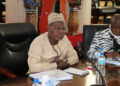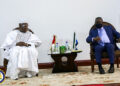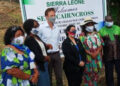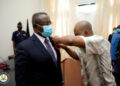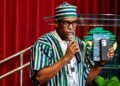

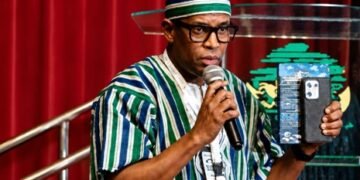


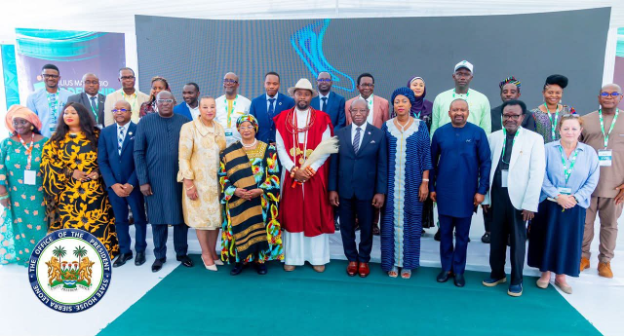
Freetown International Conference Center, Wednesday, 13 May 2026 – The Julius Maada Bio Leadership Colloquium, organized by the African Young Leadership Convergence (AYLC), convened African leaders, policymakers, youth representatives, traditional authorities, diplomats, and women leaders at the Freetown International Conference Center on 13 May 2026 for high-level discussions on the future of African governance and leadership. Held as part of activities marking the birthday of President Julius Maada Bio, the colloquium focused on the theme: “Reimagining African Leadership: Courage, Accountability, Innovation and Leadership in an Era of Global Uncertainty.”
The event served as a platform for promoting accountable governance, democratic values, innovation, and inclusive leadership across Africa at a time of growing global and regional uncertainty.
In his welcome remarks, Sierra Leone’s Vice President, Dr. Mohamed Juldeh Jalloh, described President Bio as a bold and visionary leader whose commitment to inclusive governance, democratic accountability, and human capital development continues to position Sierra Leone as an example of progressive leadership on the African continent.
Speaking on women’s leadership and inclusion, former Secretary-General of the Commonwealth, Baroness Patricia Scotland, praised President Bio for championing education, women’s empowerment, and inclusive governance. She encouraged African leaders to create more opportunities for women to assume leadership positions and contribute meaningfully to national development.
Former President of Malawi, Joyce Banda, also commended Africa’s progress in advancing women in leadership, noting that the continent has produced more female presidents than many regions around the world. She further urged governments to create sustainable opportunities for young people to address unemployment and discourage unsafe migration.
The colloquium featured a series of panel discussions on governance, innovation, accountability, youth participation, and women’s inclusion, with participants sharing practical approaches to addressing Africa’s challenges through transformative and people-centered leadership.
Delivering the keynote address, President Julius Maada Bio stated that the colloquium represented more than a ceremonial gathering or an exchange of ideas. He described it as “a reckoning, both reflection and responsibility,” stressing that Africa stands at a defining moment in its history.
“We are here to confront a defining and unavoidable question: What kind of leadership will shape Africa’s future in this century?” the President declared, emphasizing that Africa must define its own moment through decisive leadership, accountability, and innovation.
President Bio called on African leaders to move beyond symbolic reforms and pursue deliberate structural transformation capable of addressing the realities of the 21st century. He warned that “the era of managing decline while speaking the language of transformation must end,” arguing that leadership should no longer be measured by the retention of power, but by the transformation of lives and institutions.
The President further noted that Africa’s future would depend on leaders willing to make difficult but necessary decisions in the interest of their people. According to him, true leadership is revealed not in speeches or ceremonies, but in moments where responsibility comes at a political cost.
Reflecting on his own journey from soldier to statesman, President Bio recounted his decision in 1996 to hand over power to a democratically elected civilian government, describing it as an act rooted in conviction and democratic responsibility rather than political convenience. He stressed that leadership is stewardship and that no individual’s hold on power is greater than a nation’s right to democratic governance.
As Chairman of the ECOWAS Authority, President Bio also addressed the growing challenges facing West Africa, warning that governance failures, economic exclusion, and declining public trust in democratic systems continue to threaten regional stability. He argued that stability cannot be secured by force alone, but through legitimacy, inclusion, and governance that delivers meaningful opportunities for citizens.
On Africa’s place in the changing global order, the President called for stronger continental integration, expanded intra-African trade, and a united African voice in global affairs. He maintained that Africa must no longer remain at the margins of global influence, but must actively shape international developments through strategic leadership and cooperation.
President Bio also delivered a strong message to young Africans, encouraging them not to wait for perfect conditions before contributing to nation-building. He described Africa’s youth as the continent’s greatest asset, emphasizing that innovation and opportunity are being driven by young Africans across the continent.
“Leadership is not a title. It is a practice,” President Bio stated in his concluding remarks, calling on Africans at every level of society to lead with courage, reject corruption, strengthen institutions, and leave every space better than they found it.
Former Vice President Victor Bockarie Foh commended President Bio for organizing what he described as an inspiring and historic initiative, noting that it was the first programme of its kind he had witnessed under any government in Sierra Leone.
The Julius Maada Bio Leadership Colloquium concluded with renewed commitments from participants to promote accountable governance, inclusive leadership, democratic stability, and stronger African collaboration in addressing both continental and global challenges.
For media enquiries:
State House Media and Communications Unit
info@statehouse.gov.sl