




By Mohammed Kroma Esq.
The removal of Auditor-General Lara Taylor-Pearce on 20 December 2024 represents more than a personnel change; it is a landmark moment for the interpretation of independent offices under the 1991 Constitution.
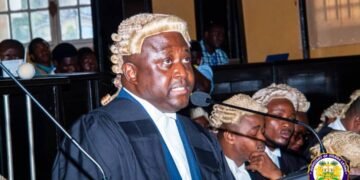
Had I been President of the Sierra Leone Bar Association (SLBA) during this period, I would have viewed it as my primary duty to ensure that the process adhered strictly to the letter of the law. The stability of our republic depends not on the outcome of such proceedings but on the integrity of the sequence.
The Mandatory Condition Precedent
The procedural history began with a significant constitutional departure. On 11 November 2021, the auditor-general was suspended prior to the engagement of a tribunal. However, Section 137(6) of the Constitution is unambiguous: a referral to a tribunal is the mandatory condition precedent for any suspension. By inverting this sequence, the process was rendered constitutionally defective from its inception. As SLBA President, I would have argued that procedural shortcuts in the removal of an auditor-general create a dangerous precedent that could eventually be applied to the removal of judges of the Superior Court.
The Redefinition of Audit Standards
The findings of the Matturi-Jones Tribunal raise serious questions regarding the intersection of law and professional auditing standards. The central allegation of misconduct involved the auditor-general’s insistence on third-party verification of hotel receipts. Far from being a lapse, this is a core requirement under the International Standard on Auditing (ISA) 505 and the Mexico Declaration on SAI Independence.
The auditor-general serves as the nation’s ‘chief editor’ of the public ledger. Her role is to verify, not to assume. To label the fulfilment of international auditing standards as ‘misconduct’ is a professional contradiction. Furthermore, the allegation that she obstructed an audit of the Freetown City Council (FCC) appears to conflate the Auditor-General’s independence with administrative failure. The fact that the Institute of Chartered Accountants of Sierra Leone (ICASL) subsequently cleared her of these charges suggests that the ‘misconduct’ found by the Tribunal was, in the eyes of the profession, an exercise of duty.
The Safeguard of Consensus
The final stage of the removal required a two-thirds majority in Parliament under Section 137(7)(b). This threshold was not intended to be a mere mathematical target; it was designed as a constitutional safeguard to ensure that the removal of an independent officer only occurs through broad, cross-party consensus. When such a threshold is met through the narrow procurement of a specific number of votes, the spirit of the safeguard is weakened. The Bar’s role is to remind the nation that constitutional protections exist to prevent the ‘mathematical’ removal of institutional checks.
The Duty of the Bar
As SLBA President, I would not have waited for the final vote to speak. The Bar should have moved early to challenge the jurisdiction of a tribunal born from an out-of-sequence suspension. We should have defended the technical reality that checking receipts is the fundamental act of an auditor, not a crime.
Lara Taylor-Pearce was removed for being faithful to the rigour of her office. When the institutions meant to safeguard the law remain silent in the face of procedural irregularity, they leave independent officers vulnerable. History will record that in 2024, the legal profession had a choice to defend the sequence of the law. We must ensure that next time, the sentinel is awake.