






What Really Happened in Sierra Leone’s Parliament, and Why the Supreme Court May Now Have the Final Word
KAMPALA, UGANDA/12 AUGUST 2026: Sierra Leone’s constitutional debate has entered dangerous territory.
What began on Monday, 10 August, as a parliamentary disagreement over the appointment of Electoral Commissioners quickly became something much larger: a confrontation over the rules by which Sierra Leone is permitted to change its own Constitution.
Opposition lawmakers walked out of Parliament after Speaker Segepoh Solomon Thomas ruled that individual provisions of the Constitution of Sierra Leone (Amendment) Bill, 2025 could be determined by a simple majority during the committee stage. Parliament subsequently voted 96 to 41 to retain the existing constitutional arrangement for appointing Electoral Commissioners.
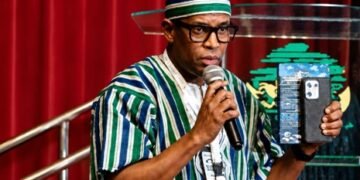
Opposition Leader Abdul Kargbo then led 49 APC Members of Parliament out of the chamber. (The Sierra Leone Telegraph)
The political drama is obvious. The constitutional question is much more important.
The real issue is this:
At what point does Sierra Leone’s constitutional two-thirds safeguard become legally operative during the passage of a constitutional amendment Bill?
That question cannot be answered by party arithmetic alone.
The Constitution draws a clear line, but leaves an important question open
Section 108 of the 1991 Constitution establishes the special procedure for constitutional amendment.
Section 108(2)(b) states that a constitutional amendment Bill cannot be passed unless it is supported, at its second and third readings, by the votes of not less than two-thirds of the Members of Parliament. (Sierra Leone Parliament)
That language is crucial.
It expressly identifies the second and third readings. It does not expressly state that every vote taken on every clause during the committee stage must independently secure two-thirds support.
This is the strongest legal foundation for the Speaker’s position.
Parliament’s Standing Order 44(1) establishes the general rule that questions in the House or Committee of the Whole are decided by a majority of members present and voting, except where the Constitution or Standing Orders provide otherwise.
Standing Order 44(3), in turn, specifically provides that a constitutional amendment Bill requires two-thirds support on the second and third readings, reflecting Section 108. (Sierra Leone Parliament)
Therefore, the Government can make a respectable textual argument that committee-stage votes are governed by the ordinary parliamentary rule unless the Constitution itself requires a higher threshold at that particular stage.
But that does not end the argument.
The Opposition’s argument is about substance, not merely procedure
The APC’s objection goes to the purpose of constitutional entrenchment.
A constitutional Bill is not an ordinary Bill. Parliament is not merely passing another statute. It is altering the supreme legal framework under which Parliament itself derives its authority.
That raises a serious constitutional question.
If Parliament can use a simple majority at committee stage to determine the substance of individual constitutional provisions, what prevents a parliamentary majority from effectively deciding the most important parts of a constitutional amendment before the two-thirds safeguard appears at the second and third readings?
The Government would answer that the final constitutional safeguard remains intact because the Bill must still secure two-thirds support at both required readings.
The Opposition’s answer is that a safeguard applied only at the end may be weakened if the substance of the constitutional amendment has already been settled through ordinary majority votes.
That is the constitutional fault line.
It is not simply APC versus SLPP.
It is a question about whether the procedural architecture of constitutional amendment protects the Constitution’s substance as well as its final passage.
What does the mathematics actually say?
This is where some of the public discussion has become misleading.
Sierra Leone’s Parliament has 149 seats, comprising 135 elected Members and 14 Paramount Chief Members. Parliament itself records the distribution following the 2023 elections as 81 SLPP, 54 APC and 14 Paramount Chiefs. (Sierra Leone Parliament)
But saying “two-thirds of 149 is 99” is mathematically imprecise.
Two-thirds of 149 is 99.33.
Because the Constitution requires not less than two-thirds, 100 votes would be required if all 149 positions constituted the relevant membership for the calculation.
But Section 30(6) complicates the arithmetic. It provides that, where the Constitution refers to a majority of all Members of Parliament, account is to be taken only of persons actually and validly existing as Members at the relevant time. The Standing Orders expressly refer to this rule in determining certain constitutional supermajorities. (WIPO Lex)
That means the first question is not simply:
“How many seats does Parliament have?”
The legally relevant question is:
“How many Members of Parliament actually and validly exist for purposes of the constitutional calculation at the relevant time?”
That distinction could become decisive.
And what about the 49-member walkout?
The walkout itself does not automatically transform Members into vacancies.
An MP who walks out remains an MP.
That is fundamentally different from a vacant seat caused by death, resignation, disqualification or another constitutionally recognised circumstance.
Parliament’s own Standing Orders make a distinction between ordinary absence and circumstances that may justify absence. Members can seek permission for absence, including for official duties, and the Speaker has defined responsibilities under the parliamentary rules concerning absence. (Sierra Leone Parliament)
But a political boycott should not casually be treated as equivalent to a vacancy.
The 49 APC MPs therefore did not simply disappear from the constitutional existence of Parliament because they left the chamber.
Their physical absence may affect the number of Members present and voting for an ordinary question.
It does not necessarily reduce the number of constitutionally existing Members against whom a two-thirds requirement is calculated.
That distinction is central.
The 96–41 vote tells us something important
The reported vote on the Electoral Commission provision was 96 in favour and 41 against, a total of 137 votes. (The Sierra Leone Telegraph)
That vote should not automatically be described as a successful constitutional amendment vote under Section 108.
Why?
Because Section 108(2)(b) specifically attaches the two-thirds requirement to the second and third readings of the Bill. (Sierra Leone Parliament)
The committee-stage vote therefore raises a different question.
Was Parliament voting merely on the handling of a clause during the legislative process, or was it effectively taking a decision that amounted to altering the Constitution itself?
That distinction is precisely where constitutional interpretation becomes unavoidable.
The Constitution is supreme over the Standing Orders
There is another principle that should not be lost in the political noise.
Section 94(1) gives Parliament power to regulate its own procedure, but parliamentary procedure remains subordinate to the Constitution.
Standing Orders cannot amend the Constitution.
Nor can a parliamentary ruling create a power that the Constitution does not grant.
The Standing Orders themselves recognise this hierarchy. Standing Order 44(1) makes ordinary majority voting the default rule except where the Constitution or Standing Orders provide otherwise, while Standing Order 44(3) expressly incorporates the constitutional two-thirds requirement for constitutional amendment Bills. (Sierra Leone Parliament)
So the Supreme Court may ultimately have to answer a deceptively simple question:
Does the constitutional safeguard in Section 108 protect only the final legislative stages, or does the constitutional character of the Bill require greater protection throughout the process?
That is a question of constitutional interpretation, not parliamentary temperament.
There is also a bigger issue hiding behind the Electoral Commission dispute
The Electoral Commission is not an ordinary government department.
Section 32 of the Constitution provides that members of the Electoral Commission are appointed by the President after consultation with the leaders of all registered political parties and subject to parliamentary approval. (Constitute Project)
The committee-stage dispute therefore concerns an institution at the centre of electoral legitimacy.
Changing the mechanism for selecting Electoral Commissioners is not merely an administrative adjustment. It can affect perceptions of electoral independence, political confidence and the credibility of future elections.
That is why the disagreement has become politically explosive.
This is bigger than the APC and SLPP
The temptation will be to reduce the confrontation to another chapter in Sierra Leone’s familiar two-party struggle.
That would be a mistake.
Governments change.
Oppositions become governments.
Speakers leave office.
Presidents leave State House.
Political parties that enjoy parliamentary majorities today may find themselves in opposition tomorrow.
A constitutional rule designed to protect democracy must therefore be judged by a simple test:
Would we accept the same rule if our political opponents controlled the parliamentary majority?
If the answer is no, then the rule is probably not strong enough.
Why the Supreme Court matters
Section 124 gives the Supreme Court original jurisdiction over matters concerning the interpretation and enforcement of the Constitution and questions about whether an enactment was made beyond the constitutional power of Parliament. (Refworld)
That makes the Court the natural constitutional arbiter of a dispute of this nature.
The Court will not merely be asked to decide whether 96 is greater than 41.
It may have to determine:
1. Whether committee-stage decisions on a constitutional amendment may be taken by simple majority.
2. Whether Section 108’s two-thirds requirement is confined strictly to the second and third readings.
3. How “Members of Parliament” should be counted when determining the two-thirds threshold.
4. Whether MPs who deliberately absent themselves from the chamber remain part of the constitutional denominator.
5. Whether Parliament’s procedural rules and rulings were consistent with the Constitution.
6. What legal consequence follows if any stage of the amendment process is found to have violated the Constitution.
Those questions reach far beyond the present Bill.
They could establish the precedent by which every future constitutional amendment in Sierra Leone is processed.
The real danger is not disagreement. It is precedent.
Sierra Leone does not have a constitutional crisis merely because politicians disagree.
Constitutional democracy is supposed to accommodate disagreement.
The danger arises when political actors begin treating constitutional procedures as instruments to be stretched according to immediate political convenience.
President Julius Maada Bio has publicly promoted the constitutional reform process, while Attorney-General and Minister of Justice Alpha Sesay has described the proposed reforms as a movement from a “constitution of survival” to a “constitution of prosperity.” (thecalabashnewspaper.com)
That aspiration is legitimate.
But a constitution cannot be modernised by weakening the very safeguards that make constitutional government meaningful.
The proposed reforms reportedly touch major questions of electoral representation, presidential elections and women’s political participation. Whatever one’s position on the substance of those reforms, the procedure used to enact them matters just as much.
A constitution is not merely a document containing political preferences.
It is the rulebook that determines how political preferences may lawfully become state power.
The question Sierra Leone should now be asking
The most important question is therefore not:
Did the APC walk out?
Nor is it:
Did the SLPP win the vote?
The question is:
Was every constitutional safeguard respected before Sierra Leone changed its Constitution?
If the answer is yes, the reform process should withstand scrutiny.
If the answer is no, political popularity cannot cure a constitutional defect.
And if the Constitution is genuinely ambiguous, then the Supreme Court must resolve that ambiguity before the country turns a disputed parliamentary procedure into a precedent for generations.
Sierra Leone has amended its Constitution before.
It will amend it again.
The issue before the country now is whether those amendments will be governed by political arithmetic or by constitutional discipline.
That is why the events of 10 August matter.
The fight is not ultimately about 96 votes against 41.
It is about who gets to decide the rules by which Sierra Leone changes the rules of its democracy.
And that is a question no political party should be allowed to answer for itself.