




By Zacharia Jalloh – Ministry of Information and Civic Education
Freetown, 28 November 2025
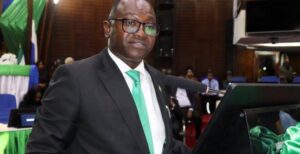
The Minister of Finance, Sheku Fantamadi Bangura, has presented the 2026 National Budget to Parliament, outlining a comprehensive plan to strengthen public service delivery, expand employment opportunities, and enhance the welfare of government workers.
Presenting the budget, Minister Bangura emphasised that the 2026 fiscal framework is designed to improve domestic revenue mobilisation through pro-poor and pro-business tax measures, leveraging innovative approaches to broaden the revenue base.
He noted that the budget aims to preserve macroeconomic stability by maintaining single-digit inflation, stabilising the exchange rate, and addressing debt vulnerabilities. He added that it also seeks to improve the business environment, boost food production, enhance food security, create jobs, and raise incomes for rural households.
A major highlight of the 2026 budget is the substantial expansion of the public sector wage bill, projected at NLe 7.9 billion. This investment will support the recruitment of thousands of new public sector workers and deliver a significant salary increase for existing civil servants. In the education sector, the government will recruit 2,500 new teachers and reassess and promote an additional 2,000 teachers effective September 2026. Tertiary institutions are also set to benefit from the recruitment of 400 new staff across universities, colleges, and technical institutes, along with the harmonisation of salaries for senior university leadership, including Vice-Chancellors and Principals, effective April 2026.
The health sector will be strengthened through the implementation of a previously approved recruitment plan for 3,000 health workers beginning in July 2026. To further motivate and retain the public workforce, the budget includes a 20 percent salary increase for existing civil servants, effective September 2026.
In addition, the broader public service will be expanded through the recruitment of 700 additional civil servants and 22 core staff for local councils, both scheduled to commence in July 2026. Key governance institutions such as the Anti-Corruption Commission, the Audit Service, and the Electoral Commission will also receive payroll adjustments to enhance their operational effectiveness.
These ambitious recruitment and salary enhancement measures reflect the commitment of His Excellency President Dr Julius Maada Bio to building a stronger, more efficient public sector. By investing in the nation’s workforce, the government aims to drive long-term national development and improve service delivery across the country.