





By Alieu Amara Suwu
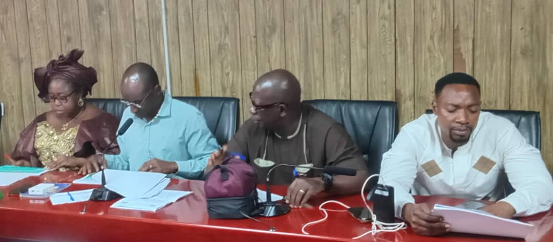
The Chairman of the Parliamentary Oversight Committee on Planning and Economic Development, Hon. Musa Fofanah has called for greater transparency, accountability, and performance from the Ministry of Agriculture and Food Security during a critical oversight engagement in Parliament.
Speaking at the committee’s first formal interaction with the Ministry, Hon. Fofanah emphasized the need for frank discussions and practical results, particularly as agriculture remains central to Sierra Leone’s national development agenda.
He noted that while the government’s flagship Feed Salone initiative aims to achieve food self sufficiency, Parliament cannot rely on reports from social media or public narratives alone.
“We have heard about onion plantations, livestock projects, and several interventions, but we need facts from the right authorities,” he stated, stressing that the committee’s role is to assess real progress and impact.
The Director of Planning at the Ministry presented an overview of the sector’s alignment with the Medium-Term National Development Plan (2024–2030), highlighting food self-sufficiency as the top national goal.
The presentation outlined key pillars including access to resources for farmers, climate-smart agriculture, youth and women empowerment, and import substitution strategies aimed at reducing the country’s dependence on imported food items such as poultry, eggs, and onions.
However, Members of Parliament (MPs) raised serious concerns over implementation gaps, questioning the effectiveness of several high-profile agricultural projects.
They pointed to issues such as poor monitoring, abandoned machinery, lack of data transparency, and weak coordination between stakeholders.
One MP criticized the apparent neglect of key agricultural regions, noting that major food-producing areas were not adequately captured in the Ministry’s presentation.
Others questioned the viability of infrastructure projects, such as bridges meant to link farming communities to markets, asking for clear evidence of their economic benefits.
The committee also raised alarm over the management of agricultural machinery distributed to farmers.
Reports of tractors and equipment left unused or in poor condition across districts, including Kabala, were highlighted as examples of waste and poor oversight.
Concerns were further expressed about past loan schemes for farmers, with MPs recalling instances where beneficiaries failed to repay loans, resulting in significant losses of public funds.
Members urged the Ministry to strengthen cost recovery mechanisms and ensure accountability in future interventions.
Youth engagement in agriculture also came under scrutiny, with MPs citing cases where government-supported farming initiatives were mismanaged or abandoned after harvest.
They called for better supervision of youth programs and improved collaboration between the Ministry of Agriculture and the Ministry of Youth Affairs.
Additionally, questions were raised about land suitability and agricultural planning, with MPs demanding scientific data to justify crop selection and investment decisions.
The issue of land grabbing and community-level conflicts was also flagged as a growing challenge affecting productivity.
In response, the Ministry officials acknowledged several challenges, including limited funding, inadequate staffing, and logistical constraints.
They noted that recruitment processes are ongoing to strengthen human resource capacity, while efforts are being made to improve monitoring and coordination.
Despite the challenges, the committee expressed willingness to work closely with the Ministry to improve outcomes.
Hon. Fofanah underscored the importance of continuous engagement, indicating that further sessions and possible field visits would be conducted to verify project implementation on the ground.
“We want to see results that align with our national development goals.
Agriculture is at the heart of this government’s agenda, and we must ensure that resources are used effectively for the benefit of the people,” he concluded.
The committee is expected to formally request detailed reports from the Ministry on ongoing projects, funding utilization, and measurable impacts as part of its oversight mandate.