



By Alpha Amadu Jalloh
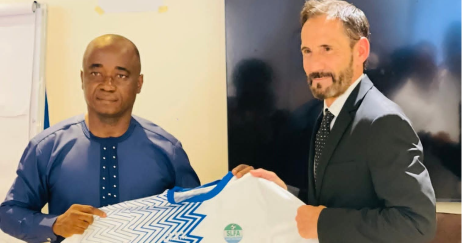
The Sierra Leone Football Association has made one of its biggest technical decisions in recent years with the official unveiling of French coach Didier Gomes Da Rosa as Head Coach of Leone Stars. On paper, this appointment appears ambitious and sends a message that Sierra Leone wants to move beyond sentiment and move toward experience. Gomes arrives with a coaching profile built across multiple African leagues and national teams and carries a reputation for discipline, tactical organisation and demanding professional standards.
The appointment has already generated optimism among supporters, but it also raises serious questions. The discussion should not only focus on whether Gomes is the right coach. The bigger question is whether Sierra Leone football is prepared to provide the environment required for him to succeed.
Didier Gomes Da Rosa is one of the most travelled coaches in African football. His managerial journey has taken him through clubs and national teams in Rwanda, Cameroon, Algeria, Guinea, Sudan, Tanzania, Mauritania, Libya, Botswana, Jordan, Qatar and Saudi Arabia. His football journey includes spells with Rayon Sports in Rwanda, Coton Sport in Cameroon, Horoya in Guinea, Ismaily in Egypt, Al Merrikh in Sudan, Simba SC in Tanzania, Mauritania national team, Botswana national team and several club assignments across North Africa and the Middle East.
His achievements have not come by accident.
At Simba SC in Tanzania, he helped deliver one of the strongest CAF Champions League campaigns in the club’s modern history. At Coton Sport he won domestic success through tactical discipline. In Botswana, he was credited with helping revive belief around the national team and played a role in their qualification progress.
Looking at his football philosophy, Gomes is not known as a coach who builds around entertainment first. His teams are generally compact, organised and physically disciplined. Defensively, he prefers structured lines with limited space between units. His teams usually defend collectively and transition quickly when possession is won.
In attack, he values direct progression rather than unnecessary possession. His approach prioritises efficiency over style.
This may suit Sierra Leone.
For years Leone Stars have demonstrated technical ability and individual talent but have often lacked consistency, tactical structure and continuity over qualification cycles. Sierra Leone has produced gifted footballers locally and abroad, yet translating individual quality into sustained national team performance has remained difficult.
This is where Gomes may bring value.
His experience across Africa means he understands realities that many foreign coaches struggle with. He understands travel difficulties, limited preparation periods, administrative challenges and player management within African football environments.
However, this appointment also comes with clear risks.
The first concern is financial sustainability.
Questions continue to circulate around outstanding financial obligations linked to previous technical leadership including discussions surrounding payments connected to former Leone Stars coach Mohamed Kallon and earlier technical arrangements under Hamidu Karim. Whether these matters are under resolution or dispute, they create concern about confidence and continuity.
A coach of Didier Gomes’ profile requires more than a contract announcement.
He requires timely salaries, functioning technical staff, organised training camps, medical support, accommodation standards and predictable administration.
Without those conditions, even experienced coaches struggle.
The second concern is institutional interference.
One of the issues repeatedly discussed in Sierra Leone football circles is the perception of interference in player selection and technical decisions. Every federation in the world receives public pressure and political interest, but successful football nations usually protect technical independence.
This may become an important test.
Didier Gomes has built a reputation as a strong personality and a coach who expects authority over football matters. If technical decisions become influenced by interests outside football merit, friction may emerge.
The third concern is support services.
Leone Stars have faced recurring concerns over camp preparation, logistics, welfare arrangements and broader support structures. Modern football success does not depend only on the coach. Analysis departments, recovery systems, player welfare, scheduling and administration now play a major role.
Sierra Leone must improve these areas if the appointment is to deliver results.
There is also another reality that cannot be ignored.
Didier Gomes does not usually remain in one place for very long.
His career history shows frequent movement between clubs and national teams. Critics describe this as instability. Supporters argue it reflects his unwillingness to remain in environments where ambition exceeds infrastructure.
Across several appointments, changes have been linked not only to football results but also to broader issues including institutional limitations, support challenges and working conditions.
That history should not be ignored.
His arrival in Sierra Leone should therefore not be viewed as a magic solution.
This appointment represents an opportunity.
If SLFA protects technical independence, if government supports the national team properly, if player selection remains merit based and if administrative standards improve, Leone Stars may finally benefit from one of the continent’s most experienced football managers.
But if old habits continue, Sierra Leone risks repeating a familiar cycle of high expectations followed by early disappointment.
Didier Gomes Da Rosa has arrived.
The next question is whether Sierra Leone football is finally ready for a coach who expects standards to match ambition.